VIRAL SHAH PORTFOLIO
Improving Organ Viability through Transport Mechanisms
Product Overview:
The goal of this product is to improve organ viability by enhancing transportation mechanisms. Currently, organ transport typically relies on two methods that don’t use preservation pumps: basic plastic coolers with ice and no tracking, or single-use products that are costly, bulky, heavy, require specialized training, and are tailored to specific organs. Our aim is to streamline this process by reducing the limitations of traditional coolers through features like temperature monitoring, compartmentalized cooling, documentation tracking, and an ergonomic box design.
Role and Contributions:
As team lead, I established and organized recurring team meetings, initially setting these up and later facilitating them twice a week. I prepared meeting agendas, created design sketches, and worked on prototyping ideas using cardboard models for the cooler box. Additionally, I identified the regulatory pathway required for FDA approval (510(k) process) and initiated hazard analysis documentation that would later be developed into a comprehensive product design specification document. This document details component properties based on risk management principles in alignment with FDA quality system guidelines. I also conducted ethnographic research, engaging with potential partners and nurses to gather insights crucial to the product's development. Performing verification and validation (V&V) testing, I performed basic cleanability tests on the organ transport box to ensure that it could be reused as per our specifications.
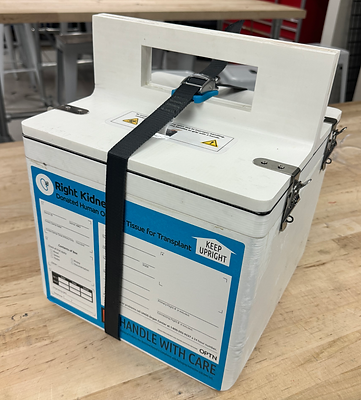

My team and I chose to explore organ transport and improving organ viability via transport mechanisms. We presented our idea to our Senior Design class to gain feedback on our idea.
I conducted ethnography targeting key partners and players in organ transport. Speaking with organ transport specialists at the Center for Organ Recovery and Education (CORE), transplant nurses, and a human factors engineer, my team and I decided to focus on organ support and stability, compartmentalization, and temperature monitoring. Issues brought to light were organs moving during transport, patient samples being tossed into the box, and no readily accessible temperature monitoring methods for single-use transport containers.

Team members: Delaney Moskowitz, Kara Nghiem, Amila Niksic, Victoria Lieu, Kevin Oh (Nurse) Jasmine Wu
Prototyping
My team and I spent a lot of time prototyping our idea starting with low-resolution prototypes, medium-resolution prototypes, and high-resolution prototypes ending with our final prototype which we froze for upcoming testing.

Low-Resolution Prototype
From left to right, our low-resolution prototypes evolved and changed based on initial feedback and research. We started with the initial sizing of current transport boxes and after quick and dirty testing, realized the size wasn't ergonomic so we shrunk the box down. After shrinking the box, we liked the prototype and made a more stable model out of cardboard for killer experiments.

Medium-Resolution Prototype
Once we finalized on an idea that we liked, we made a higher resolution prototype by 3-D printing it out of PLA. In this model, we created a 10x10 box with an inner 7x7 box. The inner box was designed to fit a rigid container, as per UNOS policy. This prototype was taken to CORE for feedback and I noted a few key points in our focus group; the walls are too thick, the contaier size varies by transport center, and the inner box may move causing similar problems.
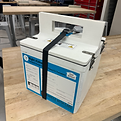
High-Resolution Prototype
After getting feedback from CORE, we created our high-resolution prototype with all key features and added the necessary stickers on the box. I helped to finish building the prototype from sanding the handles and spray painting it to attaching the hinges and ratchet strap on the box to ensure a full seal with the inner gasket. The idea behind this engineering prototype is that the hinges and ratchet strap also provide additional security so that the box cannot be opened by unwanted users.
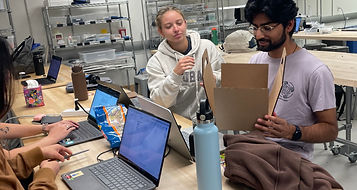
In a team meeting, we started to put together a rough model of a cooler box using cardboard to add components on and to see if our idea would work. I played around with the box to see if the design would work with our desired components.

Our low-resolution prototypes had a few components we wanted to adjust and fix, so to do this we re-printed the cardboard and started hot gluing it together to make the box with a small box on the inside to hold the organ.
In partnership with CORE, we gained insightful feedback on our prototypes from six members of their team, learned about predicate devices in use today, and learned about current procedures that must be followed.

With every prototype evolution, we tested our ideas using killer experiments to test if our ideas had any worth, or if we should rethink said idea. These experiments allowed us to test idea values in the early stages before we reached out design freeze. I performed shake tests to see if the inner box would move during transport and found that it was stable and locked in place with the inner locking mechanism we created.
Our final engineering prototype featured a temperature sensor with an LCD screen, compartmentalization for required samples (required by UNOS policy), and an internal locking box to hold the organ container.

The picture on the left shows the internal temperature of the box with six ice packs; one under the inner box, four on the sides of the wall, and one on top of the container.
The picture on the right shows the internal locking box and compartmentalization for required samples.

My team and I had to opportunity to present at the SSOE Design Expo on Dec 5, 2024, and Apr 17, 2025, on our product. Feedback from the Dec Expo was used to improve our device for the Apr Expo.

Design Expo: December 5, 2024

Design Expo: April 17, 2025
V&V Testing
I performed verification and validation testing on our engineering prototype to ensure cleanability and ensure the product can be reused for transport. The product was tested both internally and externally with our key partner, CORE. CORE users validated reusability and provided feedback on ease of cleaning and comfort with reuse.
Pictures below show validation testing with CORE and their cleaning process to clean both the inside and outside of the transport box. Results indicated that the box was easy to clean as per user standards.
Pictures below show internal verification testing of the organ transport box using CaviCide. Results indicate the box can be cleaned.
_edited.jpg)
_edited.jpg)
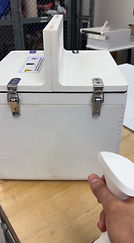


Results are promising according to test acceptance criteria; however, further testing is required to meet ISO 5 requirements and must be conducted in a sterile room. The manufactured device will be injection molded; therefore will require re-testing.